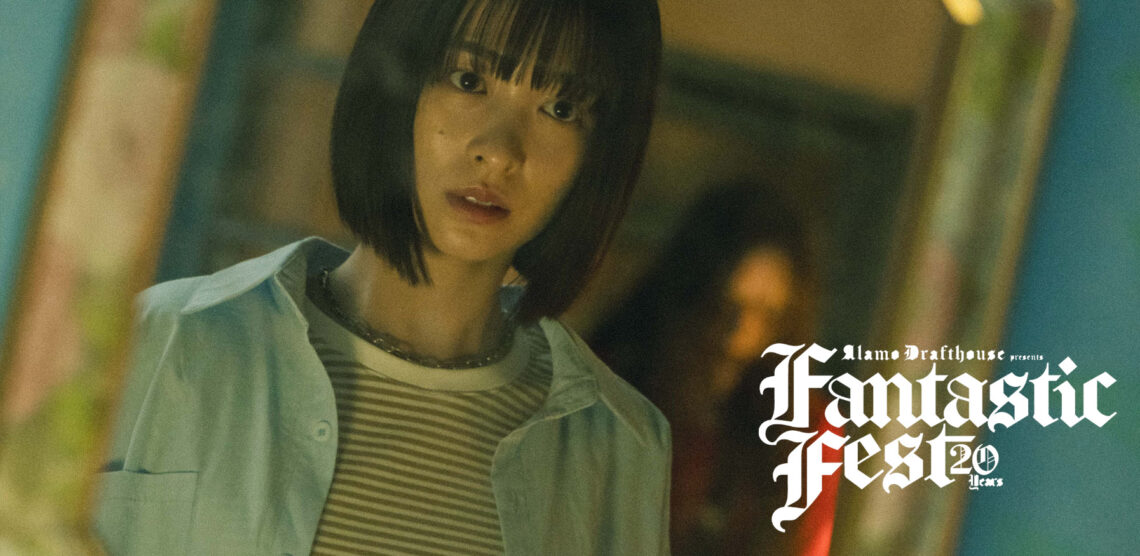
Horror comes in all shapes and sizes. Some elements come and go, while others stick around and are constantly with us. On that note, Kenichi Ugana‘s latest film, The Curse, gives us frights that not only go bump in the night, they follow us around in broad daylight. Similar to how there are no safe zones in films like The Babadook and It Follows (which also raised eyebrows and pulses at Fantastic Fest), a curse is not something that subscribes to any rules other than this: unrelenting pursuit and peril that usually ends in tears.
So, if you have a taste for something with long hair, tall shadows and sticks to you like chewing gum, then expect the expected AND unexpected with Ugana’s film. And, as a plot point that connects us with a modern audience, be careful with what you post online. It can literally come back to haunt you!
Please tell me about the power of the opening sequence in your eyes. And how in film, specifically horror, there’s a need to capture the audience interest with a mystery.
I put a lot of effort into the opening scene, so I’m very happy to hear that it’s a powerful one. It was a scene that intertwined various elements, including acting, special makeup, animals, CG, cars, and dolls. When I came up with this scene while I was writing the script, I could see the success of the film and it made me feel very happy. I don’t necessarily think that a film needs to grab the audience’s attention at the beginning, but I feel very happy when the opening scene of a horror film is successful.
What were some of your references and inspirations in crafting this story? And can you identify elements in “The Curse” that directly tie to your interests or favorite scenes from other movies?
I think it’s the same all over the world, but in recent years in Japan, I feel like there has been an increase in posts on social media criticizing people with harsher language than ever before. That’s why I wanted to depict this theme. Then, an acquaintance of mine said, “The account of a friend who passed away continues to post as if he were still alive,” and these two points inspired me to make this film. Although there was no direct influence on the scene, I was inspired by the way director Kiyoshi Kurosawa creates the worldview of his films.
Music is used very sparingly, and that helps create tension. What were some of your conversations with composer Hiroyuki Onogawa about music versus silence?
I often have him compose music for my films. The number of scores for my films is usually small, but his company handles the recording, sound editing, sound effects, and ambient sounds, and also the mixing, so we thoroughly discuss what tone we want for the entire film, and we create a worldview by treating sound effects and other elements as music.
The film deals with a curse, but what do you think? Do you believe in curses? Or do you think if they do exist, they have no power over you if you don’t believe in them? Was the paper doll curse and the exorcism in the film based on something real?
I think there may or may not be a curse. To be completely honest, it doesn’t matter to me whether there is a curse or not, and if there is one, I would think about how to capture it on film. I researched Taiwanese folklore and incorporated it into the paper dolls in the film. As for the exorcism, I got advice from a real exorcist, but because the characters in the film are set up as con artists, I deviated a little from the formal method.
Visual scares are maximized when tension is built up. How effective do you find it working with audience expectations in the horror genre, but then prolong things by putting a scare in a completely different scene. Just like when Riko investigates her apartment bathroom and then bed, only to have a scare (in broad daylight) the following day at her salon?
As the format of movies continues to change, we believe it is our responsibility to make movies that people want to see in theaters. I think maintaining the tension of fear increases the reason to see it in theaters, and I also think that the unexpected, such as something not happening when you think it’s coming, is important to get the current generation, who are accustomed to visual images, to watch a movie among the many other images available.
Are there any notable takeaways from how different audiences react in different countries? I’m curious to learn the response to tone and subject matter as you have taken your features around the globe.
I think the biggest difference in audience reactions is with laughter. In the West, laughter is often generated by one person, such as stand-up comedy or pantomime, but in Japan, laughter is often generated by a conversation between two people, thanks to the culture of manzai. Also, when it comes to horror, grotesque scenes get laughs in North America, but rarely in Japan. I think the final scene of this film would get laughs in North America, but I think most Japanese audiences would be scared. I think it’s important to understand these differences.
What scares you – both as a consumer (a horror fan) and a creative (a director)? Is a resolution more difficult to achieve in horror than leaving it unresolved? It seems that having an open end is more disconcerting and baffling than wrapping things up at the end (like the scene at the end of the credits). Agree or disagree?
Scare is something I cannot understand, both as a consumer and as a director.I feel that the concept of resolution itself has become difficult for horror films. We have come to realize that even if the source of the horror is gone, the person who experienced it cannot completely escape from that terrifying experience. However, I personally don’t think the end credits scene is an ambiguous ending.
What scene in the film surprised you the most when you see audiences react to it? And what scene are you the most proud of?
As I am answering this interview, the world premiere has yet to take place, so I don’t know how the audience will react. But I am really looking forward to it. The scene I am most confident about is the dog scene at the beginning, but I am also looking forward to seeing the audience’s reaction to the climax scene.
Do you believe in a cadence to a horror film, where there needs to be a rhythm, or is it better to be completely unpredictable (like the scene where Riko wakes up in bed)? I could never have expected that!
I’m so glad to hear that you weren’t able to predict that scene. I like to create a rhythm and then occasionally shift that rhythm, so I think both are important.
The flashback scene with Shifen’s sister, was that a different camera, or was the color/grain added in post production?
We used the same camera, but for the flashback scenes we varied it by wrapping it in saran wrap, or double-wrapping it, or wrapping it in something different.
The themes of social media mixed against what seems to be mental instability are strong. How long did it take to find a connection and have it make sense in the story. Also, it might be worth mentioning, the idea of hurting someone via social media is a main plot point in another film playing at Fantastic Fest (Appofeniacs). So it is a relevant topic worth discussing in all cultures.
For me, these two elements were intertwined from the beginning. However, it also scared me as a director because it increased the film’s ambiguity. It’s very interesting to hear that other films have similar themes. It’s not uncommon for many creators to make films with the same theme at the same time, even though they haven’t discussed it, and I think that shows that it’s a film that should be made now.
What are your thoughts on a villain who is evil just because they are evil, and not motivated by anything in particular? What is scarier to you and a better subject for cinema?
I think the latter is overwhelmingly scarier and more cinematic, because there is space for thought behind the characters.