If you love getting lost in a good book, one of the best publishers these days is Meridia. Think of them like respectable punk rock of the literary world, and they excel at brining fantastic and captivating yarns to the world. Moreover, the authors in their bullpen are as varied as they are experts in their field – technicians, aviators, directors, musicians, etc.
Multi-hyphenates in their own right, each creative brings their profession and passion to the masses via stories about sci-fi soldiers, spies and plenty more not-so-farfetched ideas. Today, we’re happy to share our conversation with Creed Bratton and Nathan Edmondson about their Civil War era story which follows two soldiers finding more respect from their enemy than their army.
It is pretty epic in its presentation yet it moves as brisk and easy as the wind through the tall grass of the fields in which much of the story is set. Hold on to your horses as Buffalos is propelled by gripping characters, tons of detail and phrases that border on poetry. War may be hell but, at times, Bratton and Edmondson make it somewhat rich and beautiful…in a Winslow Homer kind of way.
Enjoy our chat with these skilled storytellers.
GoSeeTalk: Buffalos features a pair of protagonists which isn’t too often seen in outside of certain genres (“buddy cop” movies for instance). In those cases, the characters are usually opposites in age, skill, background, etc. How did you decide on Taylor and Johnson and give them their characteristics?
Creed Bratton/Nathan Edmondson: They came about naturally; we wanted Johnson to have a contraposto, someone who would see him clearly without prejudice. We also wanted and needed an emotional tether that Johnson would have to break to fully leave the Cavalry behind. They’re each another side of the same character with different decisions.
GST: The strength of Buffalos is that it’s filled with really great descriptions both brief and lengthy. You can convey a lot about a field of waving grass with “earth in calm breath.” Then you paint a glorious image with “the Indian held some string instrument from a symphony in Hell.” Do you do this in emails and general correspondence, or is this silky prose just for your stories?
CB: Well, thank you, and I never tire of compliments, so keep them coming.
NE: I’m responsible for the silky prose, Creed is responsible for most of the punctuation. Creed actually pulls me back on occasion, tempers my instincts to write florid poetry, but then again, we both indulge the way a story pulls us in, and we love the act of writing, and a western invites so much wonderful imagery.
GST: Your novel is told through many capsule exchanges, sequences and scene-settings descriptions. Also there are large jumps in time. Given what we know about the leads, we can visualize what might happen in between what’s written. What was most important to you when spacing things out as you’ve done?
CB: It’s efficient; we could have either turned this into a long, more epic feel of a book, but we kept to a tighter, more action-oriented format.
NE: It’s our own slice of the west; we didn’t try to chase things we’ve historically loved and shared between one another.
GST: Having a pair of writers can really help the process. What were each of your responsibilities? What kind of check system do you have between you both? And what about the sharing/collaborating helped advance the story?
NE:Anytime one person has an idea, you’re stuck if it’s just one person, but with two, running them by each other, the other takes another direction or detour, and then another, and another, so bouncing back in forth advancing the story much faster and in unexpected ways than one could by themselves. We find that it absolutely true — and more and more as we’re now sitting together in Studio City working on the sequel.
GST: It seems that a lot of research was done as you put this together. It added real weight to the events and gave a seemingly honest tale of what likely happened in these times. What did you find that was noteworthy or shocking? I was not expecting to learn how huge a disconnect there was between how better equipped white soldiers were than black soldiers.
CB: We didn’t know that the powers that be in the east wanted the Indians to take of the buffalo solider problem, and vice versa. We learned how they were keen to take care of two problems — kill two birds with one stone. Also the issue of firearms ownership in the east after the Civil War; even black soldiers who fought for the Union were likely to, or had immediately lost gun rights after the war. They couldn’t even defend themselves.
GST: Reading Buffalos, what is apparent up front is that this tale is cut and dry; there’s nary a laugh or respite to the setting. It puts you in the thick of it so you feel the fatigue, and can visualize the threadbare uniforms and worn out weapons and uniforms. What physical items do you have in hand that you can refer to as you write this detail in the story?
NE: Creed is pointing right now to ta spur and cowboy boots from when he was a kid. A powder pistol and other items from the 1850s are on the mantel right here.
CB: [Holds up a rusted steel spur] When I was a kid working in the general store — at the soda fountain — the cowboys would come down the road to the hitching post and come inside to get a cup of coffee or cigarettes. I grew up in a tiny town, and saw the cowboys as a kid. I just wanted to be one of them. I just couldn’t ride that well.
GST: Given the time and setting, what kind of creative historical inspiration and narrative framework did you use for inspiration? From a cinematic perspective, I feel some Akira Kurosawa, William Wyler and Ridley Scott. What do you use as a guidepost?
NE: We kept seeing a combination of Deadman crossed with Dances with Wolves, crossed with Treasure of the Sierra Madre. Those captured the look and feel of the west. John Ford stands out. Even dirtied down John Ford.
CB: Between us, we passed several books — some research, and then Empire of the Summer Moon, Larry McMurtry and others.
GST: Each page is so dense with magnificent and memorable writing. What are you proudest of whether it was a battle, description or line of dialogue?
CB: I think we are just happy we finished it without too much fighting between us.
GST: More to the realism, you show a fierceness and reverence for the Indian tribes. The way they are depicted in battle – the war paint, the method of attack and the fear they give the regiments – their interactions and mindset are as engaging as they are eye-opening. Who did you consult to get this level of information and detail across with accuracy?
NE: Creed knew them well and could describe the 1800s Cheyenne from memory.
GST: Who is/are your favorite character(s)? Are there any that have grown on both you over time, or changed across various drafts and edits?
CB: It is truly fulfilling to explore the Native American characters, as if we are getting to spend time with them and learn about their culture. I can’t rightly choose a favorite and Nathan loves the moments between two more than just one. Especially Johnson as he learns to interact with the Cheyenne — but also, with his mama.
GST: There are plenty of pages I highlighted where story beats caught my attention. Two that come to mind are when Tyler’s Mama asks if he misses killing. His response is that “I miss there being a purpose.” The other is Tyler’s pointed question, “Why do they have us fight if they hate us so much?” What theme or element of the story means the most to you? And is anything that you had to cut that you miss not having in the story?
CB: This stemmed from the idea that I pitched to Nathan of a Buffalo soldier staring across a burning field and seeing a Cheyenne brave, and seeing an unexpected respect. Nathan was inspired by the line in research: “they found more respect from their enemy than their army.” We chased the image and that theme.
Thanks to Creed and Nathan for their time! You can get a copy of BUFFALOS at Meridia Books, and keep an eye out for more eye-opening stories from this exceptional team.
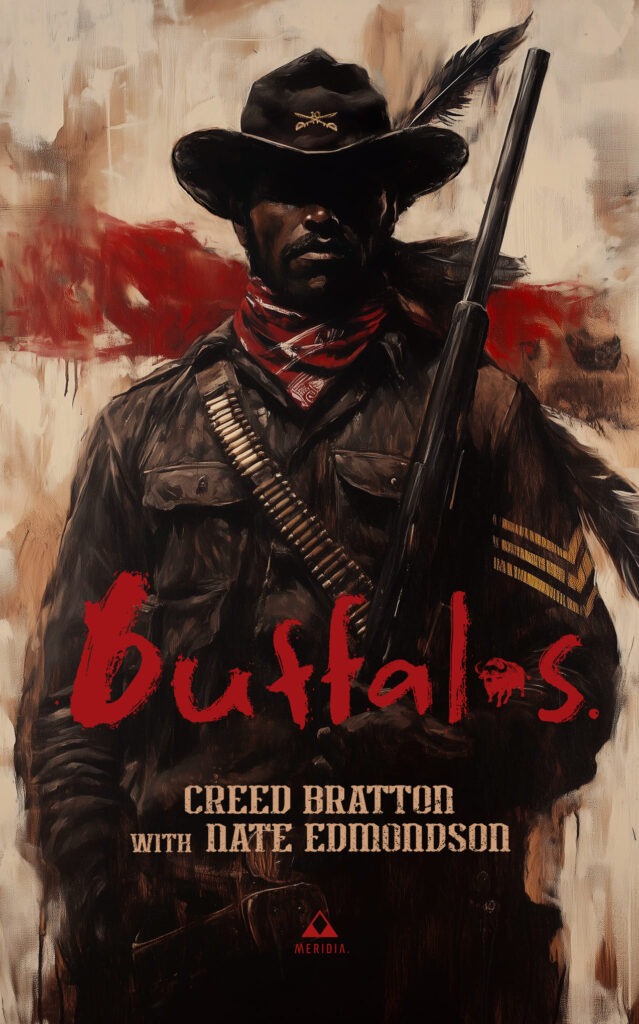
– BUFFALOS –
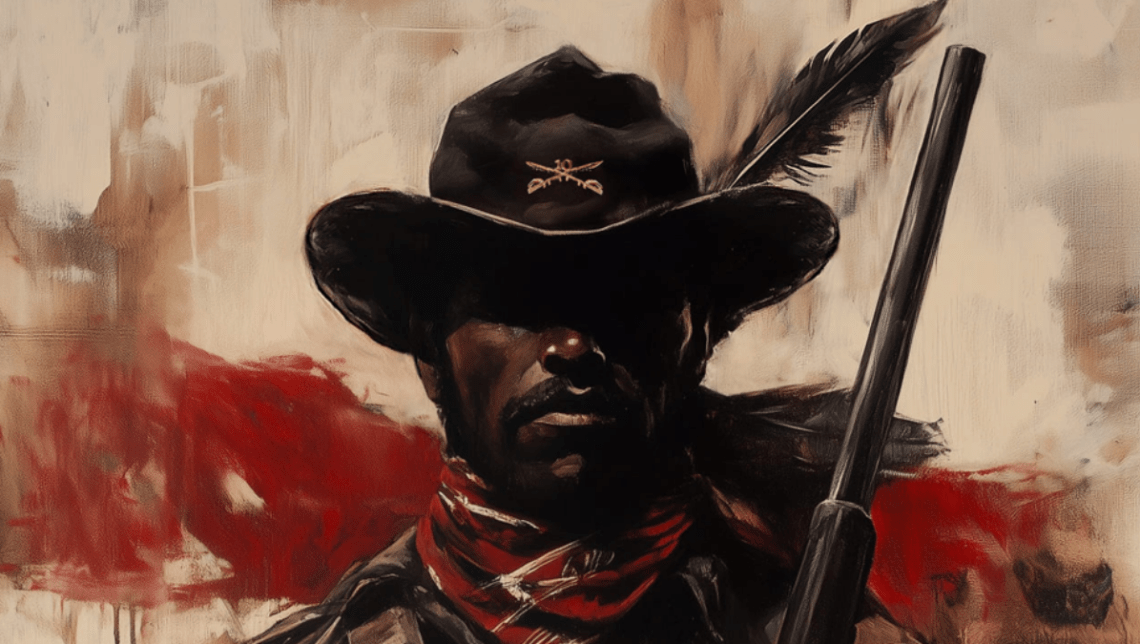
Buffalos thrusts readers into the tumultuous years following the Civil War, a time rife with uncertainty and change. Alexander Johnson trades the shackles of his past for the uniform of a soldier. Dispatched to Nebraska as part of the Army’s merciless campaign against the Cheyenne tribe, Johnson’s world is turned on its head when he finds more respect from the enemy he has been sent to annihilate than from his own command-and questions where his loyalty truly lies.
As the U.S. military advances with vigor, Johnson is caught in the crossfire. With the looming threat of brutal plains battles, he grapples with his reality; is he a friend or foe to the Cheyenne? Is he a soldier of the U.S. Army or a man fighting for his newfound family?
Buffalos is not just an action-packed Western. It’s a narrative about identity, survival, and empathy amidst a brutal conflict. A work of thrilling historical fiction, Buffalos is a “what-if” story set in the bloody plains west.