Wherever something new comes out from an artist you admire, it’s always reason to celebrate. So whether it’s turning up the volume on a new album, grabbing the remote to binge the latest season, or cannonballing onto your sofa with a new book, finding time to enjoy the things you love is one of life’s true zen-like experiences.
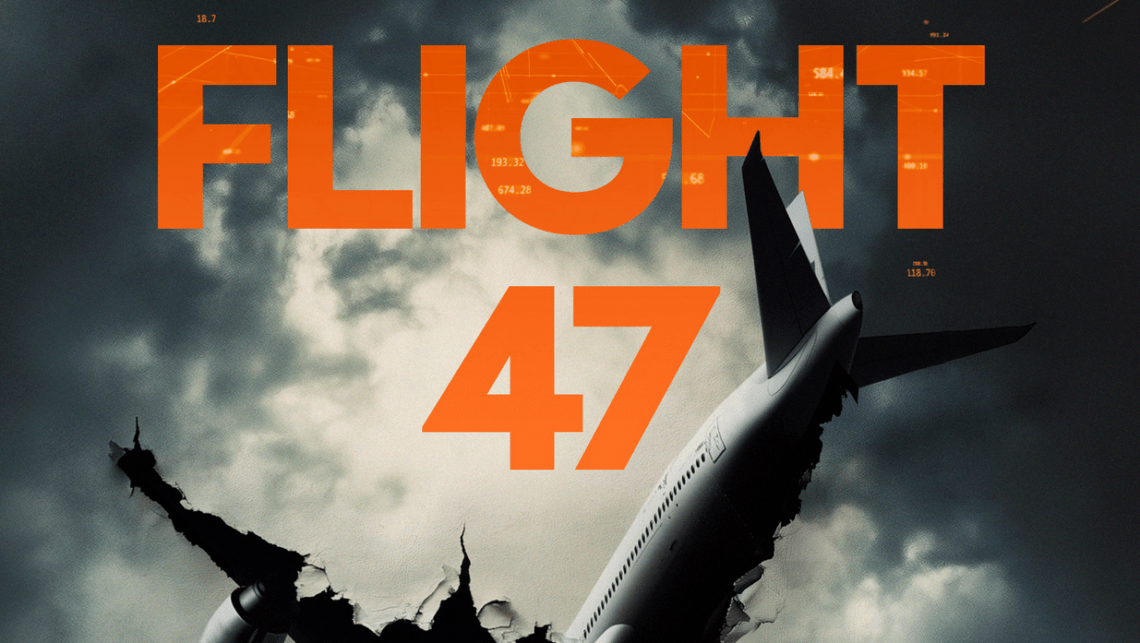
Today, we get to share an interview with an author whose work literally makes the hairs on our necks stand up. And even though we’re siting in our living rooms, we can easily imagine ourselves tethered to any of Thomas Ray‘s far-flung but eerily plausible situations. The man writes some magnetic narratives, and his latest, FLIGHT 47, is a stunner.
In this new book, we follow an aid worker who misses a flight out of Niger, only to uncover a chilling mystery—there’s no record of the plane ever existing, and no one seems to remember it at all. The story unfolds as a tightrope walk into the unknown for Casey as he desperately seeks to find his friend and the missing airliner. Tangible and weighty, you can nearly feel the pulse of the main characters.
Enjoy our session with Thomas as we get to know a bit more about what went into this and other stories.
GoSeeTalk: The last pages of THE BLACKBIRD note that you have “a diverse work background intersecting with US intelligence and military branches. He is an avid traveler and adventure seeker.” Lots to unpack there, so tell us about your interactions with the military. Also, what’s the greatest place you’ve visited, and is that material for a yet unwritten novel?
Thomas Ray: I have worked adjacent to different military units as a civilian. I have a real affection for direct action units and individuals, which is not my background at all. Yet I have spent time in several countries with these units or alongside clever specialists in the intelligence community.
I do seek adventure, and travel often. I’m a fan of both Eastern and Southern Europe, where I can often (not) be found. Yet I expect this year to be in Central America a bit on both business and research!
Greatest place? What a question. I don’t know that I have an adequate answer for that. I might highlight that I have an affection for Patagonia and for the Appian way. I can recall a few pubs where great nights were had, which might qualify!
GST: Regarding travel, what’s on your bucket list, and where is one place you are eager to visit again?
TR: I am quite eager to visit the German Christmas markets again, which I found I missed. I also am fond of Prague and would enjoy returning there. I have not been to many parts of Asia that I would gladly explore given the time and opportunity.
GST: When someone does any story about armed forces, my brain defaults the likes of Tom Clancy. Who are your heroes? Have you been able to work with any?
TR: If you mean real heroes, there are indeed many I’ve worked with, whom I don’t believe I can highlight. Some whom I have known of have recently been “discovered” on social media, which is interesting to me. I find the most laudable and impressive folks I’ve encountered are not likely to ever be publicly acknowledged.
GST: FLIGHT 47 is a triumph on many levels. Your style of writing is focused and you leave plenty of room for detail and exposition which sucks you in. But when it is fast and frenetic, it is some of the most exciting literature you could read. How did you balance so much elaborate factual theory as to “disappear an airplane” and keep it moving like a thriller?
TR: That’s very kind. I found that as I spoke particularly with pilots it guided my “what if” questions into real places, and it was a trick to navigate how something could happen, rather than simply imagine something that would.
GST: Similarly, pacing is important in your work. How did you learn to do that so well? And how do you tighten things up to keep all the pieces moving so swiftly?
TR: Much of that comes from editing, when you trim and trim, and then learn you could have trimmed some more. The reader wants to move quickly, and is often distracted. So when I am tempted to dwell on description or introspection, I have to encourage myself to “just get on with it.“
GST: The action is intense and you have a real knack for putting us in the meat grinder along with your characters. There are some tangibly claustrophobic moments in a hotel room in FLIGHT 47 as well as the finale of the story. What has been the most exciting and challenging bit for you to craft in this or any of your stories?
TR: I find it a challenge to balance what is happening to a character inside his or her head, and what is happening without. To let the reader in on just enough of the character’s thoughts—it’s key to determine only what the reader needs to know, and offer nothing more.
GST: How much inspiration is taken from real world events and news stories, and how much is you just thinking of worst-case scenarios?
TR: I tend to find that the more I can draw from the “real world,” via research or news, the more grounded and more effective a story will be. Perhaps only because I’m not imaginative or grounded enough myself!
GST: There is a car chase in THE BLACKBIRD that seems to jump off the page – it’s the true definition of a page-turner. How do you create that energy, and do you write it with any cinematic leanings or intent?
TR: I had the fortune of paring with two very cinematic and capable film directors [Jonathan & Josh Baker], which I’m sure lends to that scene. I do also enjoy action sections and passages which feel you’re trying to contain the writing into the mechanics — as in, the action seems so clear and obvious you’re pushing the words into those moments to make them alive. That scene was very mechanical, but if you’re in Jozef’s head, you’ll feel how pivotal it is.
GST: More to that point, I enjoy how effectively you illustrate the danger of any situation. The words have power and something as simple as Tom gesturing to Jozef to get in the car can quickly convey the urgency of the moment. Do you act out character mannerisms to imagine them interacting in a physical space?
TR: Not that I am aware of, especially if I’m writing on a plane, where I don’t have much opportunity for motion! [laughs] But to your point, I would find it harder to write about driving a sports car if I hadn’t driven one before, or the same for riding a horse, etc. I can’t fly a jetliner, so I may not as convincingly describe a pilot doing so…
GST: Give us some insight to one of your writing sessions. What are your rituals, and what is your method/medium? Do you write in silence, or with music or anything atmospheric in the room?
TR: I can write with music, or a good combination of sound — waves, or cafe noise — provided it’s not too loud, and has just enough chaos to have the effect of white noise. I have the typical morning coffee ritual, of course, and sometimes arriving either to a distant place or back home there’s no writing liturgy better than finding a proper bottle of wine and setting it on the desk with a glass.
GST: What is the story that has the most revisions, edits, or rewrites? And has anything changed so much that it develops into something completely different? Similarly, what’s one idea/suggestion someone gave you that took any storyline in a new direction?
TR: Goodness. FLIGHT 47 underwent many revisions. It initially had a broader scope through its center, but multiple passes saw it thinned down to be closer to Casey’s journey and little else.
I’m working on a title right now that I am deceiving myself into thinking is going one, focused way, but I’ve had conversations this week with subject matter experts which have made me want to add more and more scope.
I finished something recently that is not quite ready for primetime, but when I look back with the distance of a few weeks even I can see much word needs to be done.
GST: Are you thinking about and working on different ideas at one time, or can you stay siloed and put every effort into one idea?
TR: I have many pots on the stove, but I can only stir one at a time… so I’ve found. [laughs]
GST: Fair enough. Last question for you, Thomas. While you’re not supposed to judge a book by its cover, it’s hard not to imagine how awesome the story will be based on the stunning art associated with your novels. How much input do you have, and do those pieces start with an idea of yours?
TR: Only one was my idea, for the rest I defer to great artists and designers I’ve been fortunate enough to work with. Even if I have an idea, I have learned that a proper designer’s final product will be much better than I had imagined.
Thanks to Thomas to for his time. You can get a copy of FLIGHT 47 at Meridia Books, and keep an eye out for more gripping stories from that group. Follow Thomas Ray at his official Instagram page. If you can figure out where he is by the nebulous photos he posts, you might just have a career in the FBI…and he could use your help on his next novel!
More on his latest book below…
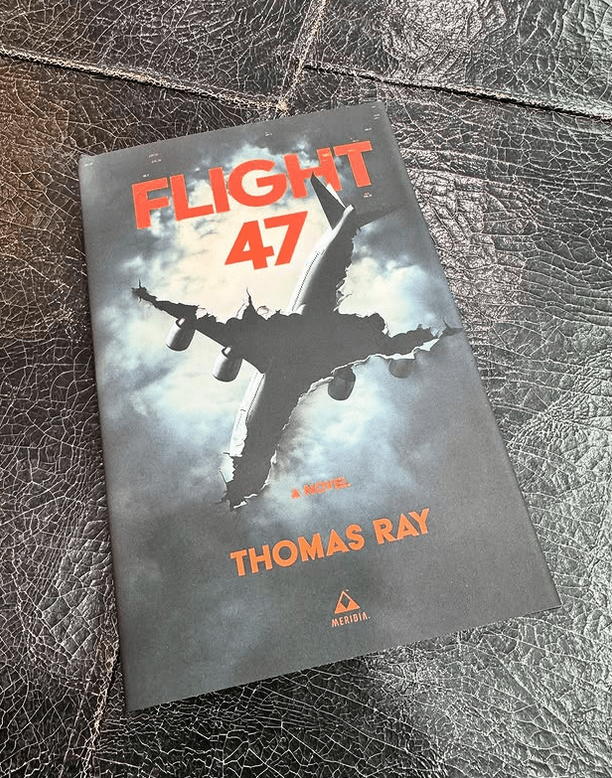
– FLIGHT 47 –
When a flight mysteriously vanishes over Niger, no one seems to care… or even notice. But a dead passenger’s loved one notices the disappearance and sets out to uncover the truth.
Photographer and philanthropist Casey Grant accidentally misses his plane, Flight 47, from Niger to the UK with his friend, Kelly. Good at her job, ever the pragmatist, and kind, Kelly was Casey’s closest friend in the country. He’d been looking forward to traveling with her and had even changed his flights to ensure they could.
Casey misses the flight thanks to a technology glitch and remains on the ground. Just 24 hours later, Casey’s on the next flight out to try to catch up with Kelly and… she’s nowhere to be found. He can’t find a way to get in touch with Kelly. No instant message, wi-fi calling, or other option turns up her voice. Moreover, the airlines can’t find Flight 47 anywhere, despite Casey having his ticket.
When Kelly doesn’t turn up in London after a few more days, Casey takes matters into his own hands. The airlines, travel agents, and even family and friends aren’t any help. Casey knows something is wrong. He missed something, and he’s determined to find the truth and his friend.
What follows is a heart-pounding international race against time as one man treks through the world to find answers to a disappearance he never expected could happen. Will Casey find Kelly, the plane, or the truth before the danger he’s unwittingly stepped into catches up with him?
Thomas Ray’s visceral storytelling makes it all too easy to get pulled into his exceptional works. Replete with fascinating detail and expert pacing, FLIGHT 47 turns on a dime. Ray excels at crafting edge-of-your-seat reading experiences. A gripping read, it will keep you guessing until the last chapter.