
Legitimacy goes a long way when telling a story. Whether the tale being told is grounded or just plain tall, it is much more impacting and engaging when they involve tangible elements. Even far-fetched ideas like teleportation and space battles can feel real when they are based on, well, real things.
While no one has figured out how to achieve quantum-anchored spatial relocation (that we know of anyway), the idea that a team of Special Missions Unit operators can warp to any point on Earth to deal with conflicts or terrorism can seem unbelievable. But when you base the action on actual rules of engagement, vernacular and the know-how that years of experiences can bring, then this means the bullets feel real and even able to leap off the page.
They say you’re not supposed to just a book by it’s cover, one look at this will easily quicken pulses and make you snatch up a copy. The good news is that Red Rovers delivers the goods as it has a lot of cinematic leanings. One thing is for sure: if you’re ever in a firefight, you’re gonna to want Rovers’ main character, Jake Foley, on your six…and your nine…and your three.
So please enjoy this chat with Leo Baker as we discuss the grit and ingenuity to the practical and sci-fi elements in his story.
GoSeeTalk: RED ROVERS is fast and surgical. I expect that has a lot to do with your experiences. Can you offer some direct elements that served as the biggest inspiration for your story?
Leo Baker: I don’t have much experience with teleportation, unfortunately, so all that is made up! The tactile elements – gun handling, etc. – are something that often feel unrealistic in books and movies. Real gun handling and equipment, including limitations like ammunition amounts and how hot suppressors can get,make those parts feel real, and you get them right or realistic when you spend time on the range.
Other things like command structure elements are not sometimes outside of my experience, or are boiled down a bit to make the book move quicker and not feel burdened with technicalities.
GST: The novel reminds me of what Rian Johnson did with Looper. Time travel is high concept, but he doesn’t spend any time on how it works – it’s just there. What was your mindset when crafting a story about this jump technology? What stories/films have been your narrative north star along the way?
LB: That’s a cool reference. Yeah, I think it’s important that it feels real, like the guns or other elements feel, but without changing the focus of the story – in this case, the focus is the operators.
GST: Also, it’s a really great idea that the controllers aren’t the ones who developed the tech. So that’s a nice idea that they all just “use it as is.” Pretty brilliant. What parts of the story are you the most proud of, and even surprised looking back now that this is published?
LB: I think that’s true of most of warfare. A soldier doesn’t design the gun, but they know how to shoot it. They also have to trust that their helicopter is well maintained so that it doesn’t crash (and helicopters crash a lot). So in a way this tech is safer, and has fewer variables, etc. At least, that’s their assumption as end-users…
But most proud of? Hmm! Good question. I like some of the action moments that are simple and could ONLY happen in this story. That’s a lucky thing to figure out. After that, as a writer, I mostly only see areas I could improve or things I want to add next time. I do like the title! I don’t know where it came from or at what point, to be honest, but I really liked it.
GST: You convey a lot of detail to help us imagine the settings; something as simple as the sound of the machine’s whump whump gets right to the point. What’s published is one thing, but I bet you have lots of scribbles (floor plans, aerial shots, ideas of Roy and things in the margins) you’ve kept as you’ve developed this, right?
LB: I am not that organized unfortunately, but did feel that the home environment was real to me, and like a place I had been or could be, especially by imagining it as an old, rehabilitated facility. One thing consistent with DOD infrastructure is its all lacking and comfort is a low priority. But also, soldiers know how to make it work.
If anything maybe I should have leaned into leaky roofs and clogged toilets and the struggle to make limited supplies into satisfying meals. At the very least operators get excellent food at their HQs, but at the Red Rovers facility, that’s not going to be the case.
GST: Chapters and events end abruptly with little fanfare yet there is power and authority to it. “They were back at the jump pad. They lowered their weapons. It was over.” And that level of getting to the point finds itself in other situations. Is that your style of writing, or a personal mindset?
LB: I think both. As a soldier you don’t stand on ceremony. You don’t congratulate yourself; quite the opposite: operators are brutal in after action discussions, so if anything, you never end on a high note. When a mission is over, you wash, break, clean your weapons, get ready to go again. Then once in a while you have a BBQ and decompress there.
GST: The story seems to move at the same speed that Jake is coming to grips with the situation. In Jake’s initiation jump, you have more than half a page of what’s happening to him. It’s a run on sentence and it helps us feel what he’s going through. How did you come up with that idea?
LB: Yeah, I at least intended for those moments to feel like a whirlwind, and a ramp up to the intensity. In real direct action scenarios, operators breach a door, throw a flashbang grenade(s) and move with “surprise, speed and violence of action.” It is truly intense, and your brain has to target and work at ten miles a second following the boom. So it’s a rush.
Jake has to be ready for that rush even more so – turned up to 10, because you can be in one part of the world and then another in a split second. One environment and then a totally distinct one, maybe in full chaos.
GST: You have a glowing endorsement from Max Martini on the back cover. Who are some of your collaborators and/or mentors and who helps you along the way?
LB: We reached out to him because we think he was the absolute best part of THE UNIT as well as many other shows in this genre. So it was wonderful to get a quote and a read from him, and he’s even promoted it on social media. He’s the best, and brings a lot of attention to the kinds of jobs and people that usually are not meant to get attention.
As far as others – there’s a forward from a real compatriot, and there are many others like him I’m grateful to and for, whom maybe one day can be named! There also are a few woven into the characters, but in a IYKYK way..
GST: With any work of fiction, some fabrication or bending the truth can be expected. But given your experience, what things are really heighten the story beats even though you know it’s an exaggeration?
LB: As I was saying, I think those technical, grounding elements, and perhaps not having anyone be too dramatic. I like cut-and-dry, with little bits of humor, but everyone is at work, and ready to work at all times. Creating that atmosphere helps. And then all the things that can and do go wrong, you just wouldn’t believe the level of Murphy’s Law that these guys see in operations. Things you could only laugh at. There’s a little of that here, and I think it makes the world seem more real.
GST: Hot wash, exfil, CQB, 2IC and others are standard vocabulary…at least from what I’ve heard in plenty of action films. What are the things you’re able to use in the story, and are there some you can’t because of some reason…due to operational hush hush, national secrecy and all that?
LB: If I can’t say I can’t say! *Laughs* Though I did use maybe less than I could have, or less than I will in the next book just to be smooth and more accessible. I’m sure there’s a line where people get irritated and taken out of the story.
GST: Research is always the fun part of creating a story. The idea that Jake and team have to use munitions specific to the region “AKs firing 7.62 rounds which would not raise suspicion when collected” is smart and perfect in the story. How much did you have to come up to speed on topics you wanted to cover in RED ROVERS?
LB: Most things didn’t require much research to be honest. Maybe I could have done more of things outside my experience. I probably will next time.
GST: I’d like to think that some of these characters are based on people you know, or an amalgamation at least. Maybe there’s even a nod to one or two with names like Dallas and Saint. To those who know you, what kind of Easter Eggs might be found in the story?
LB: *Laughs* Definitely a few!
GST: The novel sports an awesome looking cover. All the dust jackets in the Meridia line show as being done by Jonathan Baker. Any relation? And how much input do you have in the process?
LB: No relation, but a happy coincidence. I understand those guys are Australian, and there’s definitely a great SAS group out of that country that US operators work closely with. I don’t know if Jonathan was one, but he can definitely design an awesome cover!!!
GST: Tell us more about your interests and background. What do you like to do in your free time? How do you set your mind free from special ops and nail-biting scenarios?
LB: I do lots of things with my dog, I collect knives from around the world, and sometimes I do go to the range. Beyond that, mostly boring home life. I’m not that interesting. I hope to be camping and fishing more this year though!
Thanks to Leo for his time. You can get a copy of RED ROVERS at Meridia Books, and follow Leo Baker at his official Instagram page.
More on this book below…
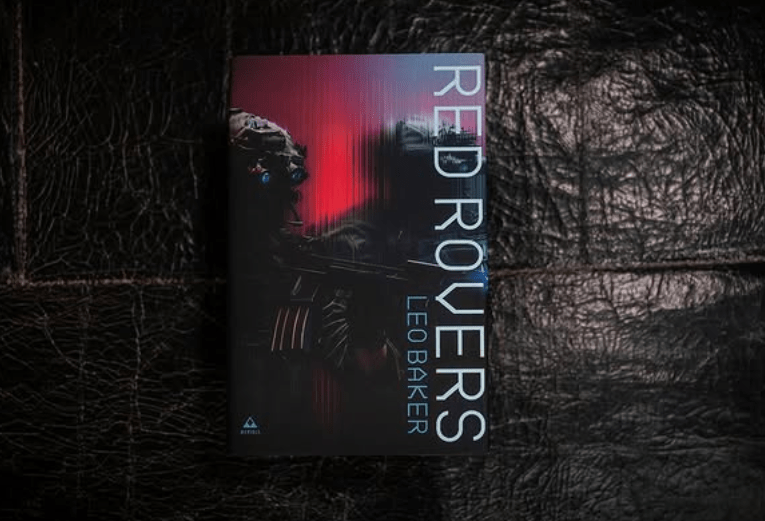
– RED ROVERS –
US Army Special Missions Unit operator Jake Foley leads his team through the Somalian battlefield on an assault against a high value target – a warlord with a well armed militia. Infil to the target involves Humvees, Helos and the coordination of drones and use of satellite imagery. Jake’s team reaches the target – only to find that he’s already been eliminated.
Jake believes that he saw something on target. He believes that someone is hiding a specialized new weapon, one that somehow just made his entire team obsolete.
Strange visitors plant breadcrumbs that lead Jake to the middle of nowhere in the New Mexico desert, where he’s invited into a secret facility hundreds of miles from where any army installation should be.
What he discovers, and what he is invited to join is a new unit, one that eliminates bad guys using a technology that defies imagination and against which the enemies of freedom have no defense…at least, not for now.